Media Luna
Pedro PáramoMedia Luna is Pedro Páramo’s sprawling estate and the material center of his authority over Comala. Its reach is described in land that stretches from one distant rise to another, while its history gathers debt, marriage, cattle, armed men, and private grief into the same place. The estate’s power is most palpable when it acts on others; its decline and silence become equally telling when Pedro withdraws that power or is no longer able to wield it.
Land, Debt, and Authority
From the road, Abundio the muleteer points out the slopes and distant heights that mark the extent of Media Luna. The whole tract visible from those vantage points belongs to Pedro Páramo. Abundio sets that expanse against the circumstances of Pedro’s sons: their mothers bore them secretly on a straw pallet, even though they were his children, and Pedro himself carried them to baptism. The contrast makes the estate more than a large property. Its land establishes a public measure of Pedro’s reach, while the lives connected to it expose the private and unequal terms of his authority.
The estate’s expansion is tied to debt as well as possession. When Fulgor Sedano reports that the last cattle have been sold and nothing remains, Pedro asks not how much is owed but to whom. He singles out the Preciado women, to whom the family owes the most and has repaid the least, and directs Fulgor to ask Dolores Preciado for her hand in marriage. Pedro tells Fulgor to convey that he loves her, then makes explicit that her money is what matters. He also says the land has no enclaves and orders the matter settled quickly. Marriage, in this transaction, is not separate from the estate’s finances: it is the means by which Pedro intends to consolidate control over property and obligations.
Fulgor’s position changes as part of the same arrangement. Pedro releases him from his responsibilities as steward and tells him to forget Media Luna, though Fulgor’s subsequent return to the estate shows that he remains bound to its affairs. The episode also reverses Fulgor’s prior expectations. He recalls that Pedro’s father, Don Lucas Páramo, had described his son as idle and unreliable, even saying that he had hoped Pedro might enter the seminary and support his mother. Fulgor had agreed with that judgment; Pedro’s rapid, hard-edged handling of the estate’s business surprises him.
Cattle, Labor, and Armed Power
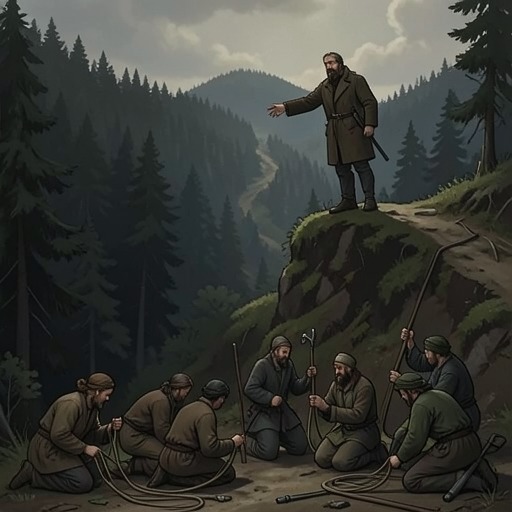
Media Luna is not only a visible expanse of land but an operating estate whose boundaries are maintained through the movement of livestock and men. In heavy rain, its large gate swings open and mounted men ride out in successive pairs until two hundred have left. Fulgor Sedano directs them to move the cattle from Enmedio beyond what was formerly Estagua, and to drive Estagua’s cattle up to the heights of Vilmayo. His repeated instructions become abbreviated for those at the rear, who hear only to move the herds from one place to another and then farther still. The scene renders Pedro’s property as a system of coordinated displacement: land and livestock are continually rearranged by orders issued from the estate.
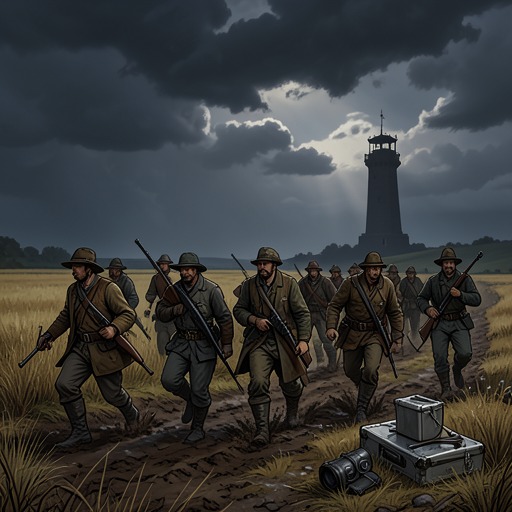
That system does not mean the estate is secure or permanently prosperous. The sale of its last cattle and the outstanding debts reveal a moment of material depletion beneath its apparent reach. Later, revolutionary fighters explain that they have rebelled against both the government and local men they regard as bandits and thieves. Pedro asks how much their revolution will cost and offers to help. The fighters’ answer leaves the sum to his generosity, making the exchange a negotiation over resources and influence. Media Luna’s wealth can support armed power, but political allegiance is also something Pedro tries to buy and direct.
Susana San Juan and the Estate’s Interior
Media Luna becomes the setting for Pedro’s attempt to keep Susana San Juan near him. He tells Fulgor that she is the most beautiful woman on earth and that he had thought her lost forever. He then instructs him to send her father back to work in the mines and suggests that the old man could disappear in a place where nobody goes. Pedro presents this plan as protection for Susana, insisting that she must be made an orphan. The language of care thus accompanies a calculated act of violence: the estate is the place where Pedro seeks to secure the woman he desires by removing her father.
The domestic rooms do not give Susana a shared reality with Pedro. In one exchange, she complains that a cat kept her awake, describing it as jumping from her feet to her head and mewing softly as if hungry. Pedro says he had fed it and insists that she has had deceptive dreams. Their disagreement leaves her experience unacknowledged by him; within the household, even a night’s disturbance becomes evidence of the distance between their perceptions.
When Susana is gravely ill, people outside the estate notice the doctor hurrying toward it and fear that she may die without confession. At her bedside, Father Rentería hesitates to administer the final sacraments because he does not know the measure of her repentance. Pedro waits nearby with his arms crossed, while the doctor and other men are also present and women remain farther back in the shadows. The estate’s rooms therefore hold both a private crisis and a public religious uncertainty. The priest’s hesitation does not resolve Susana’s suffering; it exposes the difficulty of applying a judgment of sin and repentance to her condition.
Silence, Retaliation, and Pedro’s End
After Susana’s burial, Media Luna and Comala seem to occupy opposite worlds. At the estate people walk barefoot and speak quietly; in the village, the bells have drawn crowds, music, drinking, and even a circus, and few people realize that Susana has been buried. Pedro remains in his room and says nothing. He swears revenge on Comala, declaring that he will fold his arms and let the village starve. He carries out that threat. The estate’s silence is thus not simply mourning: Pedro converts his grief into a policy that reaches beyond the property and makes its resources—or their withholding—an instrument of punishment.
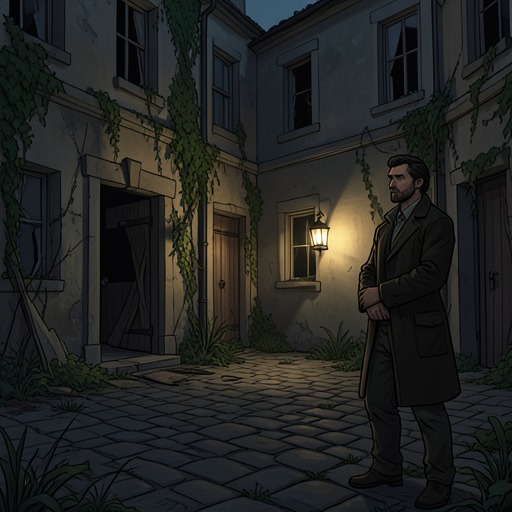
Later, Pedro sits alone in an old chair by the entrance to Media Luna, awake and uncertain of sleep or time. He recalls the last time he saw Susana: she was leaving along the path toward heaven, passing the sacred tree in the estate’s avenue and carrying away its last leaves. He calls for her to return. The memory makes the estate’s landscape part of his private recollection, but it also underlines the finality of her absence. The entrance, once a point from which orders and visitors could pass, becomes the place where Pedro waits with nothing left to command from his grief.
That gate also frames his final encounter with Abundio the muleteer, who arrives drunk and asks for charity to bury his wife. Pedro calls Damiana Cisneros to see what the man wants. After Abundio is carried away, Pedro watches the procession toward the village and finds that his left hand will no longer lift from his knees. He sees the sacred tree shake and drop its leaves, and thinks of those who leave by the same road. When he tries to walk with Damiana’s support, he takes only a few steps before falling heavily to the ground. Media Luna has been the source and instrument of his dominance; at its entrance, that dominance ends in helplessness. The estate remains, but the man whose will organized its land, cattle, and reprisals can no longer rise from its threshold.